Mutual Recognition Agreement (MRA)

The Mutual Recognition of Professional Association Credentials Agreement was formed on the 20 November 2008 and has been updated since this date. The signatories to the agreement include:

You may be eligible to apply under the MRA if you:

  • completed your qualifying speech pathology qualification in a member country (United States of America, Canada, Ireland, New Zealand or United Kingdom) AND
  • hold current full membership of your home professional association as outlined below:
    • American Speech-Language-Hearing Association (ASHA) - Certificate of Clinical Competence - Speech-Language Pathology (CCC-SLP)
    • Speech-Language & Audiology Canada (SAC) - Certified Speech-Language Pathologist (S-LP(C))
    • Irish Association of Speech and Language Therapists(IASLT) - (MIASLT)
    • New Zealand Speech-language Therapists' Association (Incorporated) (NZSTA) - Full Member (with the exception of those who graduated before 1993)
    • Royal College of Speech and Language Therapists (RCSLT) - Certified Member (Cert MRCSLT)
    AND
  • Are able to provide a Letter of Good Standing from your Home Association.

UPDATE: 02/04/2025

Please note due to recent changes in licensing requirements in Canada, SPA is not currently accepting MRA applications from SAC members. Applicants from Canada are welcome to apply via the Overseas Qualified Competency Assessment (OSQCA) process.

The Agreement:

  • is NOT one of reciprocity or reciprocal recognition of qualifications;
  • permits under some conditions for certified or full members of one association to become recognised by the other associations;
  • does NOT ensure migration to any of the other countries; as all conditions for migration have to be met, and
  • does NOT ensure employment in the country which the speech pathologist may wish to visit.

Fees and payments

A payment invoice will be generated and sent via email to you once your application has been received in full.

  1. Fee for migration skills assessment: The application fee of $825 (Australian dollars) must accompany the application form. You can apply up to 3 times within a 2-year period. The application fee covers all 3 applications within the 2-year period.
  2. Fee for withdrawing application: If the withdrawal is requested prior to the assessment commencing, a full refund will be considered, less an administration fee of $100 (Australian dollars).
  3. Fee for reviews and appeals: The fee for lodging an appeal against Speech Pathology Australia's decision is 25% of the initial application fee or $206 (Australian dollars) which must be paid at the time of submitting the written appeal.
  4. Fee for replacement assessment advice: N/A
  5. Payment methods: The full application fee must be paid at the time of lodging a written application for migration skills assessment.
  6. Refund policy: This fee is non-refundable

Skills assessment criteria

To be eligible for a skills assessment you must meet the recency of practice requirement. To meet this requirement, you must have evidence that you have worked as a speech pathologist for a minimum of 1000 hours in the past 5 years. Travelling to Australia to work as a speech pathologist before you complete a skills assessment is STRONGLY discouraged.

1. Preparatory information and resources

If you are a current certified practising or full member of ASHA (USA), IASLT (Ireland), NZSTA (New Zealand), RCSLT (UK), SAC (Canada) or Speech Pathology Australia, you should refer to additional information about the MRA between ASHA, NZSLT, IASLT, RCSLT, and SAC on their respective websites.

2. Guide for applicants

The guide for applicants provides detailed information including:

  • What to include in your application.
  • How to present your evidence.
  • The assessment process.
  • The appeal process.

Please read the guide carefully prior to completing and submitting your application.

Please note you are advised to refer to the web version of the Mutual Recognition Agreement (MRA) Guide for Applicants. Printing a hard copy is not recommended. You must submit your application based on the criteria that is on the web at the time of submission. Any major changes to requirements will be communicated to all applicants as appropriate.

Listen to SPA's Speak Up podcast - what you need to know if you are an Overseas qualified speech pathologist and you want to work in Australia.

3. Skills assessment

4. Required documentary evidence , including translation requirements


Please read the guide carefully prior to completing and submitting your application.

Please note you are advised to refer to the web version of the Mutual Recognition Agreement (MRA) Guide for Applicants. Printing a hard copy is not recommended. You must submit your application based on the criteria that is on the web at the time of submission. Any major changes to requirements will be communicated to all applicants as appropriate.

To ensure your submission is processed correctly, please follow these guidelines:

  1. Attach All Required DocumentsPlease submit all items of evidence by email . You may upload your documents into a Dropbox folder; we do not accept Google Drive folders. Please share the link to your Dropbox with [email protected]
  2. Image Quality Standards
    • All items of evidence must be photographed in full colour. Please ensure these are of a high quality to enable identity checking.
    • The entire document, including all edges, must be clearly visible in each image.
    • Avoid shadows, glare, or obstructions that could make the document unreadable.
    • Your passport and photo identification must show both main pages (see samples)
  3. File FormatEnsure images are in a standard format (e.g., JPEG or PNG). Please ensure your document names are no more than 50 characters. Documents with long names will not be accepted.
  4. Important Note If your documents do not meet these requirements, you may be asked to resubmit them.. Not following these guidelines will lead to delays in processing your application

If you have any questions about the process or documentation requirements, please email skills assessment.

5. Educational requirements

You must have completed your professional education to become a speech pathologist in a country that is signatory to the MRA Agreement as below and be able to produce a letter of good standing at the time of submitting the application:

  • American Speech-Language-Hearing Association (ASHA) -Certificate of Clinical Competence -Speech Language Pathology
  • Speech-Language and Audiology Canada (SAC) – Certified Speech-Language Pathologist (S-LP))
  • Royal College of Speech and Language Therapists (RCSLT) Certified Member (Cert MRCSLT)
  • Irish Association of Speech and Language Therapists (IASLT) – Full Member
  • New Zealand Speech-Language Therapists’ Association (NZSTA) – Full Member (with the exception of those who graduated before 1993, who are not eligible to apply under this agreement).

6. Skills requirements

Speech pathologists in Australia need to work with English as the vehicle of communication and as the focus of assessment and treatment.

Applicants under the Mutual Recognition Agreement, who hold an entry level Speech Pathology qualification conducted in English from a university in the United Kingdom, Canada, New Zealand, United States of America or the Republic of Ireland, are not required to provide evidence of English language competence.

Application process

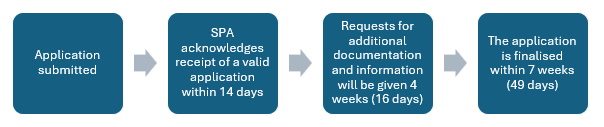
1. Outline of end-to-end process flowchart
2. Processing times

Assessments of applications for MRA take up to 7 weeks from receipt of the complete application. These cannot be fast tracked.

3. How to obtain status updates

Once your application/portfolio has been allocated to an assessor you will receive an email confirming the due date for your assessment. There are no status updates available until you receive your suitable or not suitable outcome letter by the due date.

4. Next steps – suitable and not suitable outcomes

The overseas application process provides applicants with two years from initial submission to complete the process. If you receive an unsuccessful outcome, you have two further opportunities with your current application to submit evidence over the two-year time frame. Your suitable outcome letter is valid for 2 years.

5. Review/appeal process

Speech Pathology Australia will consider appeals of unsuccessful outcomes. To find out more click here.

6. Reassessment

Should you not achieve a successful outcome within 3 years you may submit a new MRA application.